ECECDC Chairman and Former Prime Minister of Spain Zapatero Meets with Vice Chairman of the CPPCC Leung Chun-ying and Chief Executive of the HKSAR John Lee Ka-chiu
On 9 June 2025, Mr. José Luis Rodríguez Zapatero, Chairman of the Europe-China Economic Cooperation and Development Council (ECECDC) and former Prime Minister of Spain, met with Mr. Leung Chun-ying, Vice Chairman of the National Committee of the Chinese People’s Political Consultative Conference (CPPCC), and Mr. John Lee Ka-chiu, Chief Executive of the Hong Kong Special Administrative Region (HKSAR). Dr. Zichen, recipient of the 18th World Outstanding Chinese Award, Chairman of the AI Committee of the World Chinese Business Investment Foundation, and Executive Director and President of Alpha Technology Group Limited (Nasdaq: ATGL), was invited to attend the exchange meeting. The discussions focused on Hong Kong’s role as a “super connector” and “super value creator,” and on how to further enhance exchanges between China and Europe, particularly Spain.
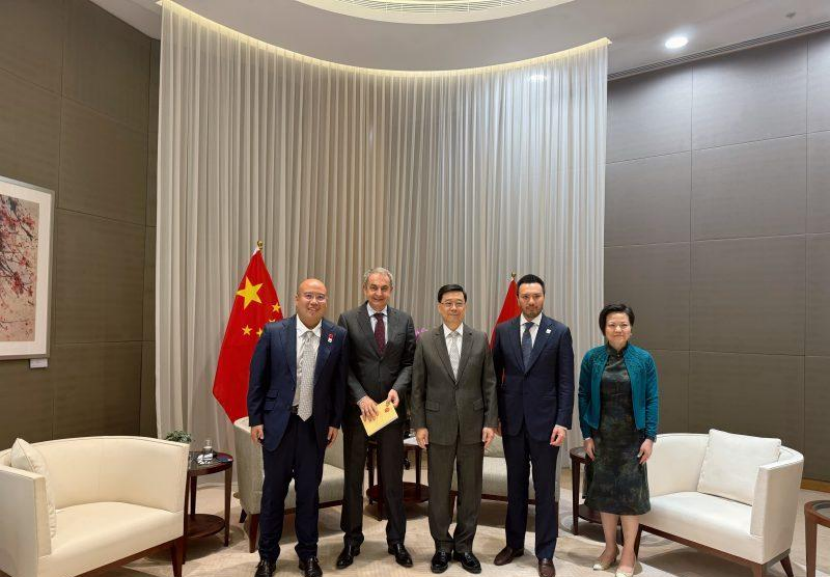
The meeting also centered on the successful implementation of the “One Country, Two Systems” policy in Hong Kong and its current economic development, with in-depth exchanges on key topics related to artificial intelligence. Both sides expressed their intention to promote future cooperation between Hong Kong and Europe in the fields of science, technology, and innovation.
According to media reports, when speaking about technological development, former Prime Minister Zapatero described artificial intelligence as a “qualitative leap” in the history of technology. He noted that AI represents not only technological progress, but also poses challenges to models of coexistence within human society. He further called for the establishment of robust ethical norms and strengthened global cooperation to regulate and guide the development of artificial intelligence.
During his visit to Hong Kong, former Prime Minister Zapatero placed particular emphasis on educational exchanges, cooperation among universities, and collaboration in vocational education. He emphasized that, from a medium- to long-term perspective, exchanges in education and culture help consolidate and promote friendly relations among countries and regions worldwide, enhance people-to-people connectivity, and enable all parties to discover more shared common ground.